
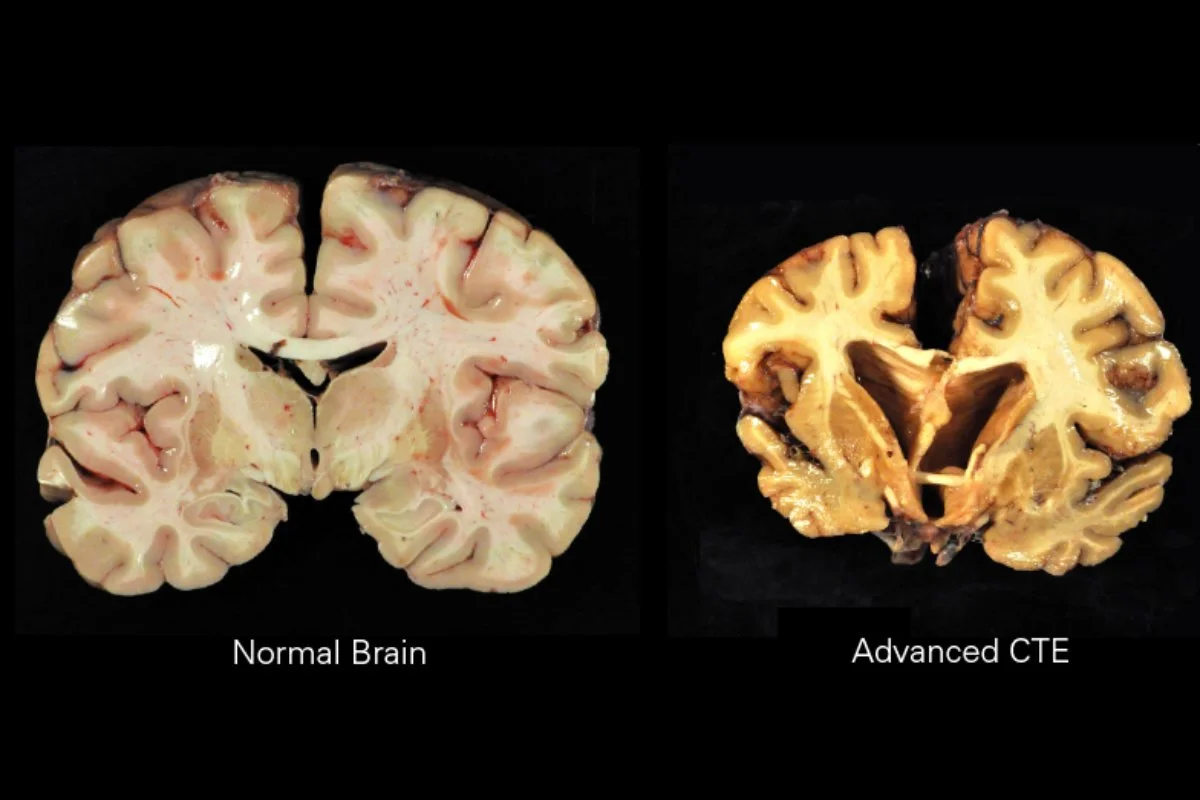
Image attribution: Boston University Center for the Study of Traumatic Encephalopathy, CC BY-SA 4.0, via Wikimedia Commons.

This article was initially published in the 11/19/26 edition of our Concussion Update newsletter; please consider subscribing.
Julia Gallini and colleagues at Boston University's School of Public Health published a study in JAMA Network Open estimating that almost 75% of the 2362 former National Football League (NFL) players who died between 2008 and 2023 had chronic traumatic encephalopathy (CTE) neuropathology. CTE is a degenerative brain disease found in individuals who have sustained repeated blows to the head and can only be diagnosed after death. CTE is most prevalent in high-contact athletes, first responders, and the military, and is rare in the general population (about 1%).
While ~75% of this group had CTE neuropathology, a smaller subset, 27.2%, had been diagnosed with all-cause dementia during their lifetime. Helio author Shawn Arraj spoke with lead author Gallini, who "emphasized that the [CTE] prevalence estimates do not reflect the percentage of deceased NFL players who showed symptoms of CTE while alive…A portion of these players likely had no noticeable symptoms while they were alive, and another portion was likely experiencing only mild symptoms." This study builds on previous research estimating that at least 25% of former NFL players who died between 2016 and 2021 had CTE, as well as responses to that research.
A CBS News article added a caveat to the study. Dr. Kristen Dams-O'Connor, the director of the Brain Injury Research Center at Mount Sinai, said "the results of the paper 'cannot and should not be interpreted as being representative of current living athletes.'" In the last few years, the NFL has made rule changes to try to decrease the likelihood of concussions. Dr. O'Connor also noted that "the results could not be applied to the 'vast majority of people who played youth football' or other non-professional contact sports."
The study sample included 2,362 deceased NFL players, including brain donors (396) and non-donors (1,966). Out of the donors, the researchers found that 93.5% had CTE. To account for selection bias, the researchers calculated that individuals are 5 times more likely to arrange for brain donation if they experienced negative symptoms in their lifetime, resulting in the 74.5% prevalence estimate and a conservative lowest estimate of 63.7%
CTE is often thought to have a silent phase, with unidentifiable changes happening in the brain. However, Dr. Jay Alberts, director of the Cleveland Clinic Concussion Center, notes that some changes may be identifiable. He says that "what we need to do is listen more carefully and use better measurements to understand what those changes are." These measurements could include daily skills, such as driving and balancing a checkbook, that require both cognitive and motor skills. In other neurological diseases, these skills start to erode five to seven years before diagnosis, and CTE may be similar.
Ongoing studies are trying to identify biomarker changes associated with CTE. A study site at UT Health San Antonio is following current and past players and evaluating their brains and behaviors to identify any abnormal changes. In the last 10 to 20 years, there have been rapid advances in Alzheimer's therapies, and researchers are hoping to translate these findings to many other neurodegenerative diseases like CTE.