
Resources for Professionals
Despite consensus that concussion education for healthcare providers is a public health priority, there is ample evidence that such education is hard to come by: see this 2024 study, 2023 study, and our blog post on a 2022 study. Concussion Alliance is addressing these gaps in concussion management knowledge by providing information and education for healthcare providers on current best practices.
Provider Webinar Recording

A Patient-Centered Approach to Concussion Care for Emergency Medicine and Primary Care Physicians
Concussion Alliance and Elizabeth Sandel, MD, have produced a prerecorded webinar, A Patient-Centered Approach to Concussion Care for Emergency Medicine and Primary Care Physicians. The program is also informative for other healthcare professionals, coaches, and patients. This 45-minute learning activity is free. This program is hosted by Med Learning Group.
The Concussion Update Newsletter

Our monthly Concussion Update newsletter provides thoughtful synopses of new research, news related to concussions, listings of free webinars, and calls for study participants for research.
Approximately 40% of our 4,500 newsletter subscribers are professionals: healthcare providers, school professionals, sports professionals, and attorneys.

Resources for School Nurses

Concussions can have physiological effects on brain function, leading to mood changes and cognitive difficulties, in addition to the physical symptoms commonly associated with concussion. Concussion, recovery, and persisting symptoms can all affect a student as they begin their return to a classroom and physical activity. In this resource, we highlight suggestions for interacting with parents and students, as well as provide resources to help support the student in their return to school and sport.
Quick Guides for Patients
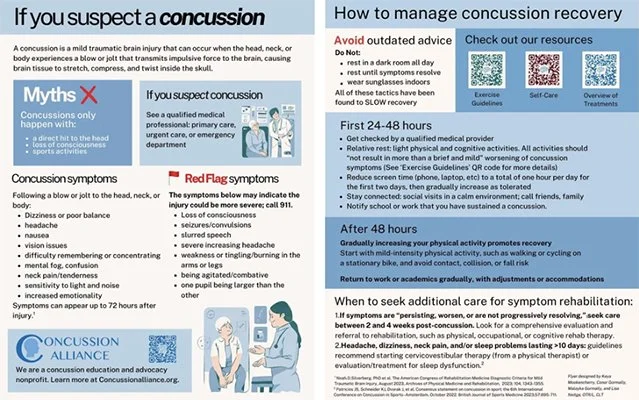
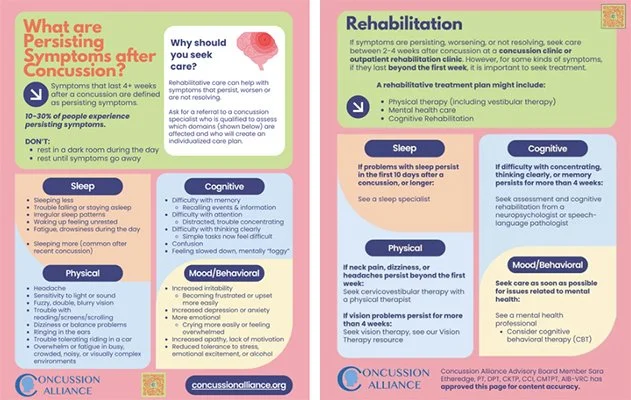
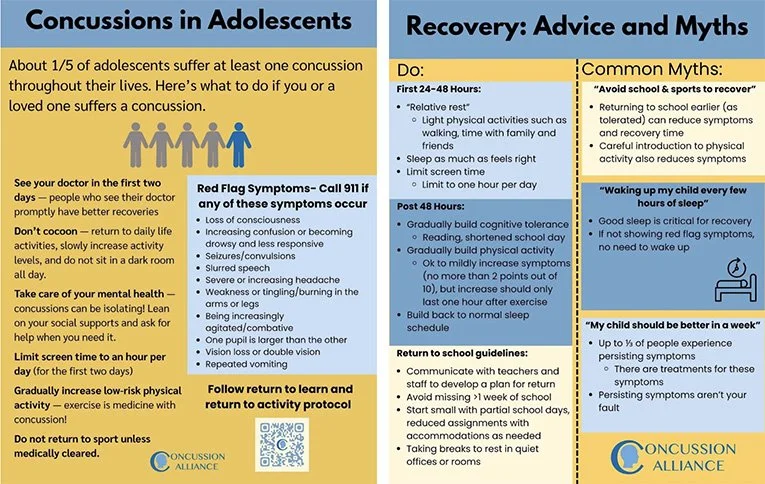
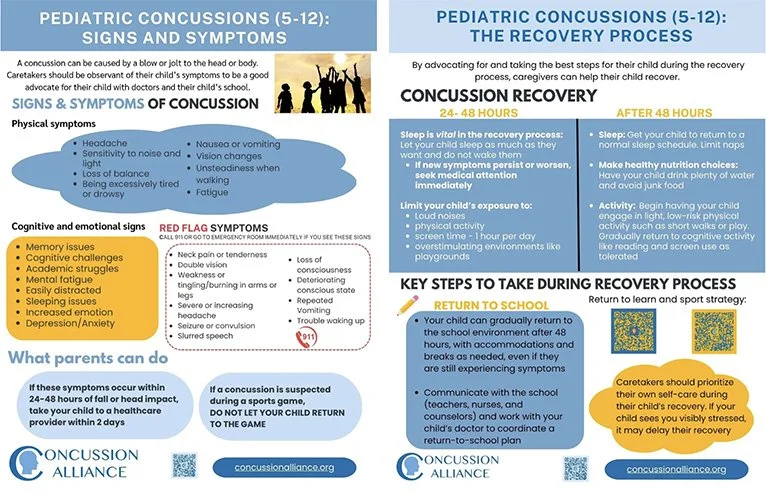
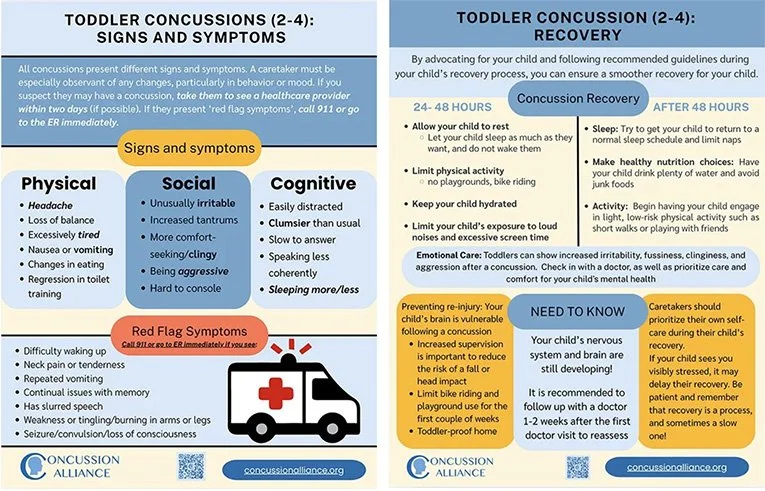
The following Quick Guides can be downloaded to provide to your patients:
Navigating Your Concussion, Persisting Symptoms (PCS) Guide, Adolescent Concussions (Age 13–18 Years), Pediatric Concussion (Children Age 5–12 Years), Toddler Concussions (Age 2–5 Years), and Infant Concussions (Age 0–24 Months).

Return to School Protocol
This Return to School strategy below was developed by PedsConcussion and incorporates the most recent concussion guidelines. Scroll below this chart for instructions on how to implement this Return to School strategy.

Instructions for using the Return to School strategy
The instructions and definitions below are from Pedsconcussion.
"Students should begin a gradual increase in their cognitive load with the goal of minimizing time away from the school environment. The return to school should not be restricted if the student is tolerating full days.
Progression through the strategy may be slowed when there is more than a mild and brief symptom exacerbation**; however, missing more than one week of school is not generally recommended.
Definitions:
*Relative rest: activities of daily living, including walking and other light physical and cognitive activities, are permitted as tolerated.
**Mild exacerbation (worsening) of symptoms: No more than a 2-point increase when compared with the pre-activity value on a 0-10-point symptom severity scale.”
***"Brief" exacerbation of symptoms: Worsening of symptoms for up to 1 hour.
***0-10 point symptom severity scale: Please see the Visual analog scale for an example of a 0-10 symptom severity scale.”

Return to Activity/Sports Protocol
Youth athletes
It is OK if your patient starts a gradual return to sport at the same time that they are gradually returning to school.
The patient should be fully returned to school BEFORE they return to full sports activities.
A gradual return to sport is essential; see the Return to Activity/Sport Protocol below.
Your medical clearance is required before your patient returns to “any activities at risk of contact, collision, or fall (eg, multiplayer training drills).” This means medical clearance before Step 4 in the protocol, e.g., before high-intensity non-contact training drills or drills in which players are close enough to each other to risk an inadvertent head impact from a ball, for example.
Return to Activity/Sport Protocol
We recommend the Return to Sport Protocol developed by Pedsconcussion. Scroll down for instructions on how to use this Return to Activity/Sport Protocol.

How to use the Return to Activity/Sports Strategy
When using the Return to Sport strategy in the chart above, follow these instructions from Pedsconcussion.
“Begin Step 1 (i.e., relative rest) within 24 hours of injury, with progression through each subsequent step taking a minimum of 24 hours. If more than mild exacerbation (worsening) of symptoms (i.e., more than 2 points on a 0-10 scale***) occurs during Steps 1-3, stop the activity and attempt to exercise the next day.
People experiencing concussion-related symptoms during Steps 4-6 should return to Step 3 to establish full resolution of symptoms with exertion before engaging in at-risk activities. Written determination of medical clearance should be provided before unrestricted Return to Sport as directed by local laws and/or sporting regulations.”
Definitions
“*Relative rest: activities of daily living, including walking and other light physical and cognitive activities, are permitted as tolerated.
**Mild exacerbation (worsening) of symptoms: No more than a 2-point increase when compared with the pre-activity value on a 0-10-point symptom severity scale***. "Brief" exacerbation of symptoms: Worsening of symptoms for up to 1 hour.
***0-10 point symptom severity scale: Please see the Visual analog scale for an example of a 0-10 symptom severity scale.
These definitions were harmonized with and modified with permission from the Amsterdam International Consensus Statement on Concussion in Sport).”