Report from Capitol Hill: Concussion Alliance co-founder lobbying for concussion care (3/19/26 Newsletter)
This week, our lead article, Report from Capitol Hill: Concussion Alliance co-founder lobbying for concussion care, is in the Advocacy category.
Also in this newsletter:
Writers: Malayka Gormally, Zoe Marquis
Editors: Conor Gormally, Malayka Gormally, & Zoe Marquis
Do you find the Concussion Update helpful? If so, forward this to a friend and suggest they subscribe.
Opportunities
Concussion Alliance programming
Monday, March 30, 3 pm PT: Virtual Happy Hour & Community Q&A. No pre-registration required; click on the event link to join the Zoom call.

Other Opportunities
March 20–22: Love Your Brain Summit: Holistic Healing After Brain Injury. A 3-day online conference for patients, caregivers, and providers, centering on evidence-based holistic therapies for brain health and healing, including neurofeedback, trauma-informed mindfulness, gut-brain health, and non-invasive brain stimulation.
Tuesday, March 24, 6 pm ET: A free webinar, Brain Injury & Concussion in Olympic and Paralympic Sports, hosted by the University of Florida Brain Injury, Rehabilitation, and Neuroresilience (BRAIN) Center. Register here: https://bit.ly/4kRGT9n.
Tuesday, March 24, 6 pm ET: A free webinar, Exercise Therapy for Concussion, presented by Dr. Mark Bayley, hosted by the Canadian Concussion Centre. Register in advance.
Ongoing: Love Your Brain Online yoga, mindfulness & education programs. These six-week programs run in April, July, and October. Participants may choose between group discussion programs and yoga and discussion programs. There are also affinity group programs for caregivers, BIPOC, athletes, and other communities.
Call for participants: If you live in Nova Scotia, you may be eligible to participate in a study on disparities in concussion education and recovery protocols within Nova Scotia's Black populations. Working at Acadia University with Dr. Colin King, Master's of Kinesiology student Michaela Dankwa is looking for adults of African, African Nova Scotian, and Caribbean descent, as well as professionals who work with these communities, to complete brief, one-on-one interviews about their experiences. While the study focuses on the lived experiences of Nova Scotia’s Black population, anyone 18+, regardless of racial and ethnic backgrounds, is welcome to complete the questionnaire and contribute to this research. Contact 0309782d@acadiau.ca for more information.
Advocacy
Report from Capitol Hill: Concussion Alliance co-founder lobbying for concussion care
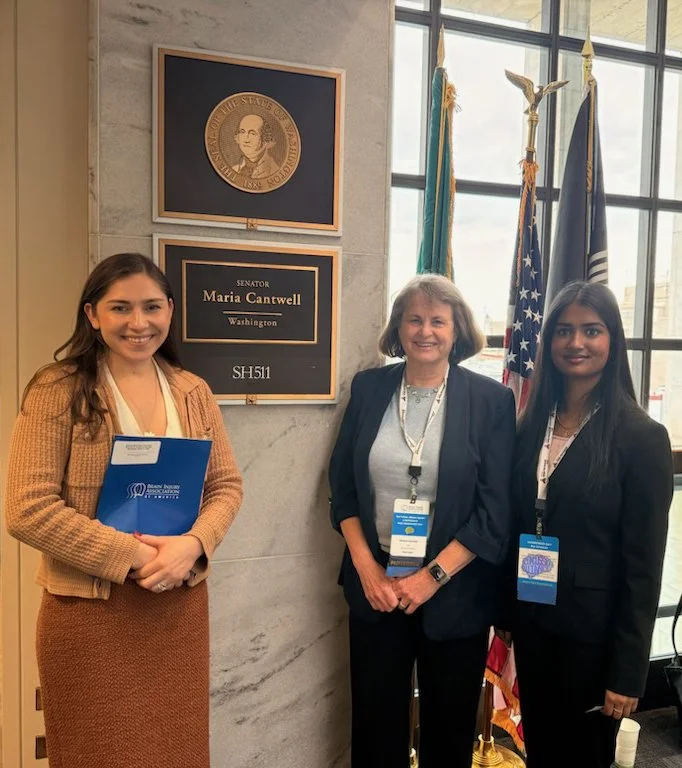
Left to right: Tamara Allard, Legislative Assistant for Senator Maria Cantwell; Malayka Gormally, Concussion Alliance Co-founder; Anushka Nag, intern with the Brain Injury Association of Georgia.
Written by Malayka Gormally.
Last week (March 11th), I was honored to serve as the State Lead for Washington State on Capitol Hill in Washington, D.C., joining a group of 234 advocates representing 39 states and territories who met with legislators as part of the Brain Injury Association of America’s National Brain Injury Conference and Awareness Day. As a group, we had two legislative requests: reauthorization of the Traumatic Brain Injury Act, which includes concussion research and education under the CDC TBI and Heads Up programs, and the enactment of a Brain Injury National Action Plan to address the fragmented system of care for brain injury in the US. Additionally, I also shared information about Concussion Alliance resources with several Senate offices. I represented Washington State because Concussion Alliance is registered as a 501(c)(3) nonprofit organization in Washington, where I am a resident, although Concussion Alliance provides education to a worldwide audience.
I met with aides to Washington State Senators Patty Murray and Maria Cantwell, and joined Georgia advocates in meeting with aides to Senators Raphael Warnock and John Ossoff. Our first request was that our legislators sponsor and promote the reauthorization and full funding of the Traumatic Brain Injury (TBI) Act, which lapsed 18 months ago. This will enable the hiring of staff to run the CDC TBI and Heads Up programs, after the entire team was eliminated on April 1, 2025, during the DOGE-led Reduction in Force (see our articles here and here). The team is needed to monitor and update the extensive Heads Up website resources and six video training coursesfor school and sport professionals. Forty-three states have legislation mandating concussion education for student-athletes. Most of these state laws recommend the CDC training course for coaches, resulting in 150,000 youth sports coaches taking the course each year. Monitoring and updating these courses is critical to keeping coaches up to date and young athletes safe.
Additionally, before they were eliminated, the previous CDC TBI team was about to publish an update to the 2018 management guide for physicians on the Diagnosis and Management of Mild Traumatic Brain Injury Among Children. The update would incorporate the new guidelines from the 6th Consensus Statement on Concussion in Sport, published in 2023. A newly formed TBI team could also continue its work on the National Concussion Surveillance System, which published a pilot survey that found that concussion prevalence in the United States is 17 to 30 times higher than previously estimated. This pilot study was meant to be the first step in a new data system to improve how the U.S. tracks concussions.
The TBI Act reauthorization will also cover the Administration for Community Living, a program partnering with states, territories, and tribes to provide community-based TBI services.
We also asked our legislators to sponsor the enactment of a new Brain Injury National Action Plan, which would establish an Advisory Council to make recommendations to strengthen care for brain injury throughout the U.S. Thanks to a panel presentation the day prior to our visit to the Capitol, I was able to convey the rationale behind the proposed action plan to the legislative aides. Geoffrey Manley, MD, PhD, talked about how TBI care is fragmented, with systems of care spotty at best. He referenced a 2022 consensus study report, Traumatic Brain Injury: A Roadmap for Accelerating Progress, published in The National Academies Press. The authors recommended an improved TBI classification system and better systems of care, with uniform TBI care pathways across the country, as cardiac care is today. Kelly Parker, LMHC, with the Wounded Warrior Project, noted that service members with training and combat TBIs encounter a fragmented system that includes the Department of Defense, the VA, and Medicare, and that difficulties navigating this system during their transition to civilian life put them at high risk of suicide.
Traumatic brain injury has been called the signature injury of the Iraq and Afghanistan conflicts, and TBI is now the signature injury of the current U.S. war with Iran. As of March 19, at least 140 of the 200 injuries are TBI-related, according to a U.S. official. As an education and advocacy nonprofit, we see that concern about blast exposure is high; some of the most visited and shared items on our website are about blast injury exposure in training and combat. I conveyed to the legislative aides that supporting a Brain Injury National Action Plan is especially timely, as service members are sustaining brain injuries in Iran and the Middle East region.
Youth
Moderate recreational screen time is associated with fewer psychological symptoms and better recovery after concussion

Limiting screen time after a concussion is common advice, but a recent study published in the Journal of Neurotrauma suggests that, for adolescents, allowing moderate screen time after a concussion may be best for recovery. Researchers João Paulo Lima Santos et al. investigated the effect of recreational screen time on anxiety and depression symptoms in adolescents after concussion. 102 adolescents participated in the study, including 62 adolescents with concussion and 40 healthy controls. The researchers assessed participants’ anxiety and depression symptoms in the first ten days after concussion and again at three months after concussion. During the first assessment, participants were also asked how long they spent on screen-based recreational activities in the last week.
The researchers identified three clusters in screen time use: low (averaging 1.97 hours per day), moderate (averaging 5.22 hours per day), and high (averaging 8.96 hours per day). Concussion symptom severity was similar across all clusters. At the first assessment, all participants in the concussion group had elevated anxiety and depression symptoms compared to the control group, likely due to their injury. However, at the second assessment, participants in the moderate screen time group no longer had elevated anxiety and depression symptoms. On the other hand, the low screen time group had elevated anxiety, and the high screen time group had elevated depression compared to controls. The moderate screen time group also showed better recovery than the low and high screen time groups. The researchers suggest that recommendations for a “Goldilocks” approach to screen time after concussion may be beneficial for adolescents—not too much, not too little, but just the right amount.
The researchers propose a few explanations for their findings. Based on previous research, they suggest that excessive screen time may have adverse effects on emotional dysregulation, which could be exacerbated after concussion. Alternatively, they note that excessive screen time may impact sleep, which in turn affects emotional regulation. Conversely, low screen time may limit digital coping mechanisms, such as stress relief or social connection. With the increased stress of concussion, these resources likely serve as an important way to manage anxiety. Limitations of the study include the fact that screen time was self-reported and lacking for many controls, the fact that screen time estimates could span pre- and post-injury periods, and the lack of data on pre-injury psychological symptoms.
Note: International Guidelines recommend no more than one hour per day of screen time in the first 48 hours after a concussion.
From the Archives
Earlier PT rehab for persisting symptoms is better for balance control & reaction times

A study by Campbell et al. published in Physical Therapy highlighted that, for patients with mild traumatic brain injury (mTBI) who were experiencing continued symptoms (beyond four weeks), earlier physical therapy intervention was associated with faster symptom recovery compared to those receiving delayed physical therapy. Notably, for those with persisting symptoms, an early start to a 6-week physical therapy rehabilitation program resulted in improvements in balance control, but delayed physical therapy did not. The earlier physical therapy group showed a faster rate of improvement as well as a beneficial effect in the sensorimotor aspects of balance control. The delayed physical therapy patients had decreases in motor activation (likely due to the delay) that “can be interpreted as a maladaptation,” making patients “less able to resist external disturbances.”
In an OSHU press release, OSHU neurologist Dr. Laurie King notes that up to 30% of those who have a concussion experience lingering symptoms past four weeks post-injury––and that earlier rehab aims to provide more support, facilitate faster recovery and address changes in balance early on. When physical therapy is delayed, the brain appears to over-rely on vision to compensate for dysfunction in the vestibular system, thus creating poorer balance control and reaction times. Dr. King notes that these deficits may lead to patients avoiding physical activity and may also explain why there are “higher rates of re-injury after a first concussion.” She notes that the ideal window to seek physical therapy is within two months of an mTBI event. After that point, patients could experience more prominent deficits in balance and sensorimotor control functions. “There seems to be a window of opportunity within two months,” King said. “After that point, the brain compensates in a way that’s not good.”
The study, administered by physical therapists at OHSU, looked at the ideal physical therapy timing via a randomized control trial, comparing an early start to a 6-week rehabilitation program to a significantly delayed start to the program. 160 Patients were randomly assigned to two groups. The earlier group of mTBI patients started the 6-week rehabilitation program within 1 week of baseline testing (performed at study enrollment) within 2-12 weeks of injury. The later (delayed) rehabilitation group had a 6-week waiting period (after their baseline testing upon enrollment) before commencing the rehabilitation program.
The 6-week program included 8 physical therapy sessions with a physical therapist over six weeks, plus home exercises. Each 60-minute session focused on the cervical spine, cardiovascular, static balance, and dynamic balance. Outcomes were assessed primarily with the Dizziness Handicap Inventory and secondarily with patient-reported measurements of sensorimotor balance control and objective measures of balance.
Delayed physical therapy can negatively affect patient outcomes related to sensorimotor balance and points to a need for more informed guidelines in the primary care setting as well as early physical therapy referral and intervention after mTBI to effectively address any lingering symptoms related to concussion.
You Can Support Concussion Patients

Join our community of monthly donors committed to improving how concussions are prevented, managed, and treated, thereby supporting long-term brain health for all. Learn more.
You can also make an impact with a one-time gift or tax-friendly options such as Donor Advised Funds (DAFs), IRA Charitable Rollovers, and Planned Giving: leave a gift in your will. Learn more.