By Malayka Gormally. This article was initially published in the 12/11/25 Edition of our Concussion Update newsletter; please consider subscribing.
A “proof-of-concept” study found that 8-10 weeks of at-home treatment with a transcranial photobiomodulation (tPBM) device resulted in statistically significant improvements in cognitive function in adults exposed to repetitive head acceleration events (RHAE). Similar results have been demonstrated in case studies, many of which we have covered (a hockey player, four retired football players, and earlier pilot studies). The study by Spencer W. Liebel et al. is one of the largest tPBM studies focusing on traumatic brain injury (44 participants), and one of the first to focus specifically on RHAE, which includes exposure to a broader group of injury mechanisms that repetitive head impacts (RHI), such as whiplash, personal violence, and military blast exposure.
Published in Photobiomodulation, Photomedicine, and Laser Surgery, the authors explain that “PBM is thought to reduce inflammation of brain tissue and encourage neuronal proliferation.” This study found that tPBM stimulated neuroplasticity in specific areas of cognition that are “commonly affected by neurotrauma” and that are vulnerable to neurodegeneration. To learn more about PBM, we recommend watching this recent ABC News interview with a former football player and leading PBM researcher, Dr. Margaret Naeser.
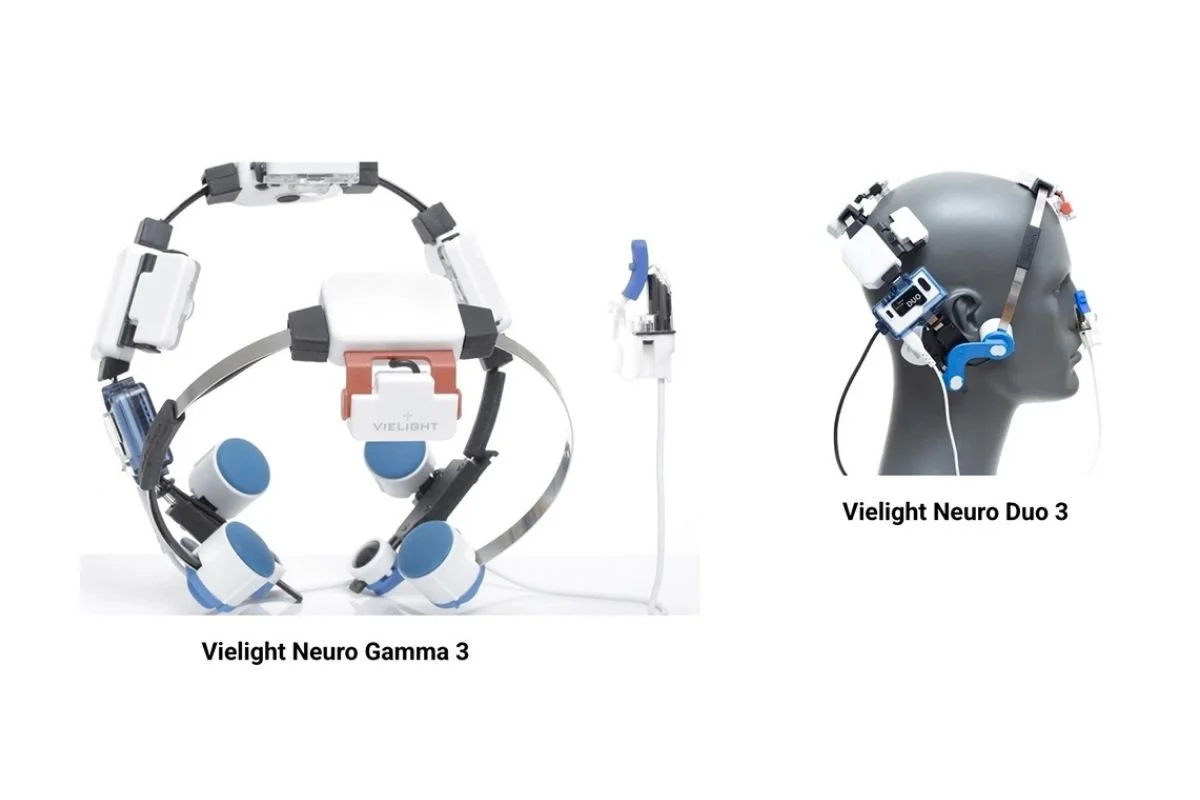
The study at the University of Utah involved 44 participants with a self-reported history of RHAE. Participants had experienced a median of 6 TBIs and 12 years of RHAEs, and they had no history of psychiatric disorders or neurological disease. They were given a battery of cognitive tests before and after the tPBM treatments: verbal memory and learning, executive function, attention, and inhibitory control and fluid cognition (“the ability to solve novel problems, reason abstractly, and adapt to changing situations without relying on prior knowledge.”) Participants were given a tPBM device (a Vielight Neuro Gamma 3), worn on the head, that delivers pulses of light at particular wavelengths. Specifically, the Neuro Gamma 3 delivers near-infrared light at 810 nanometers, pulsed at 40 hertz, through 4 transcranial LED lights and one intranasal (in the nose) LED light. Participants were instructed to use the device for 20 minutes every other day for 8-10 weeks.
Vielight devices are available for purchase on their website, and no prescription is needed; the current equivalent device is the Neuro Gamma 4. (Concussion Alliance has no financial connection with Vielight.)
After the intervention, at the group level, statistically significant increases with moderate to large effect sizes were found in “fluid cognition, processing speed, learning and memory, attention, working memory, and certain aspects of executive function.” On the individual level, the changes were smaller, as “0–36% of participants showed reliable improvement across cognitive measures, depending on the subtest.” The researchers note that several factors may influence this finding, including test-retest reliability, and they state that the findings on the individual level “should not diminish the promising improvements seen at the group level in these early studies of PBM.”
While this study did not examine whether these improvements held over time, the researchers are still following this group of participants and expect to publish in the future on the longer-term effects of this tPBM intervention. This was not a clinical trial; there was no control group given sham devices, and the authors recommend such a trial. Additional limitations include the lack of diversity among participants (primarily white males), varying exposures to RHAE, self-reported RHAE history, and limited group size.
