Report from Capitol Hill: Concussion Alliance co-founder lobbying for concussion care
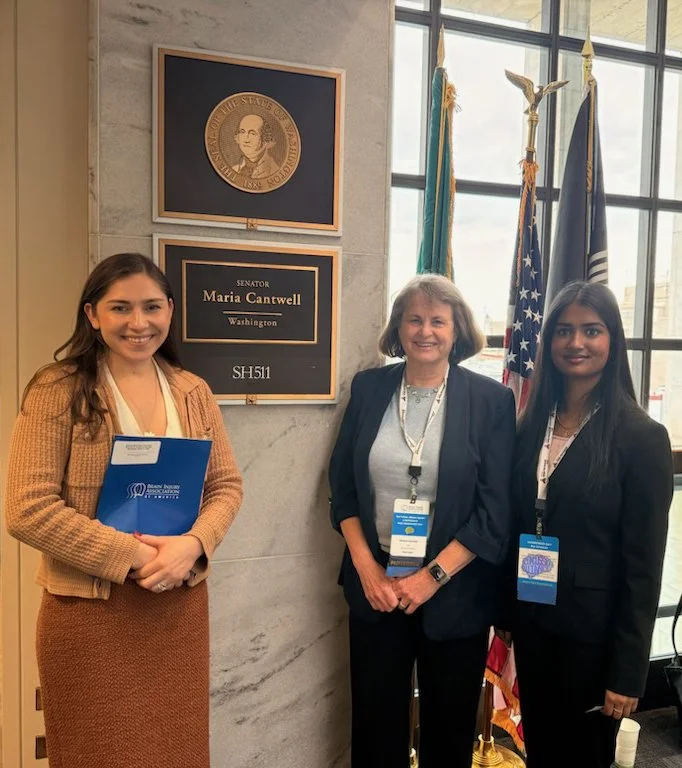
Left to right: Tamara Allard, Legislative Assistant for Senator Maria Cantwell; Malayka Gormally, Concussion Alliance Co-founder; Anushka Nag, intern with the Brain Injury Association of Georgia.
This article was initially published in the 3/19/26 edition of our Concussion Update newsletter; please consider subscribing.
Written by Malayka Gormally.
Last week (March 11th), I was honored to serve as the State Lead for Washington State on Capitol Hill in Washington, D.C., joining a group of 234 advocates representing 39 states and territories who met with legislators as part of the Brain Injury Association of America’s National Brain Injury Conference and Awareness Day. As a group, we had two legislative requests: reauthorization of the Traumatic Brain Injury Act, which includes concussion research and education under the CDC TBI and Heads Up programs, and the enactment of a Brain Injury National Action Plan to address the fragmented system of care for brain injury in the US. Additionally, I also shared information about Concussion Alliance resources with several Senate offices. I represented Washington State because Concussion Alliance is registered as a 501(c)(3) nonprofit organization in Washington, where I am a resident, although Concussion Alliance provides education to a worldwide audience.
I met with aides to Washington State Senators Patty Murray and Maria Cantwell, and joined Georgia advocates in meeting with aides to Senators Raphael Warnock and John Ossoff. Our first request was that our legislators sponsor and promote the reauthorization and full funding of the Traumatic Brain Injury (TBI) Act, which lapsed 18 months ago. This will enable the hiring of staff to run the CDC TBI and Heads Up programs, after the entire team was eliminated on April 1, 2025, during the DOGE-led Reduction in Force (see our articles here and here). The team is needed to monitor and update the extensive Heads Up website resources and six video training coursesfor school and sport professionals. Forty-three states have legislation mandating concussion education for student-athletes. Most of these state laws recommend the CDC training course for coaches, resulting in 150,000 youth sports coaches taking the course each year. Monitoring and updating these courses is critical to keeping coaches up to date and young athletes safe.
Additionally, before they were eliminated, the previous CDC TBI team was about to publish an update to the 2018 management guide for physicians on the Diagnosis and Management of Mild Traumatic Brain Injury Among Children. The update would incorporate the new guidelines from the 6th Consensus Statement on Concussion in Sport, published in 2023. A newly formed TBI team could also continue its work on the National Concussion Surveillance System, which published a pilot survey that found that concussion prevalence in the United States is 17 to 30 times higher than previously estimated. This pilot study was meant to be the first step in a new data system to improve how the U.S. tracks concussions.
The TBI Act reauthorization will also cover the Administration for Community Living, a program partnering with states, territories, and tribes to provide community-based TBI services.
We also asked our legislators to sponsor the enactment of a new Brain Injury National Action Plan, which would establish an Advisory Council to make recommendations to strengthen care for brain injury throughout the U.S. Thanks to a panel presentation the day prior to our visit to the Capitol, I was able to convey the rationale behind the proposed action plan to the legislative aides. Geoffrey Manley, MD, PhD, talked about how TBI care is fragmented, with systems of care spotty at best. He referenced a 2022 consensus study report, Traumatic Brain Injury: A Roadmap for Accelerating Progress, published in The National Academies Press. The authors recommended an improved TBI classification system and better systems of care, with uniform TBI care pathways across the country, as cardiac care is today. Kelly Parker, LMHC, with the Wounded Warrior Project, noted that service members with training and combat TBIs encounter a fragmented system that includes the Department of Defense, the VA, and Medicare, and that difficulties navigating this system during their transition to civilian life put them at high risk of suicide.
Traumatic brain injury has been called the signature injury of the Iraq and Afghanistan conflicts, and TBI is now the signature injury of the current U.S. war with Iran. As of March 19, at least 140 of the 200 injuries are TBI-related, according to a U.S. official. As an education and advocacy nonprofit, we see that concern about blast exposure is high; some of the most visited and shared items on our website are about blast injury exposure in training and combat. I conveyed to the legislative aides that supporting a Brain Injury National Action Plan is especially timely, as service members are sustaining brain injuries in Iran and the Middle East region.
