
Veterans Day Special Edition
We would like to recognize and thank veterans for their service this Veterans Day. To mark this day, we are sharing resources for veterans and those who care for them, including family, friends, and the healthcare providers who show up to care for patients with service-related traumatic brain injuries, PTSD, and mental health conditions.
This week, our lead article, HERO study investigates heart rate variability biofeedback therapy for veterans and service members is in the Potential Treatments & Self-Care section..
Do you find the Concussion Update helpful? If so, forward this to a friend and suggest they subscribe.

In this newsletter: Our Resources for Veterans, Heart Rate Variability Biofeedback Therapy, Talkspace Online Mental Healthcare, and Provider Education: Working with Veterans.
Writers: Zoe Marquis & Malayka Gormally
Editors: Malayka Gormally & Zoe Marquis
Do you find the Concussion Update helpful? If so, forward this to a friend and suggest they subscribe.
Our Resources for Veterans
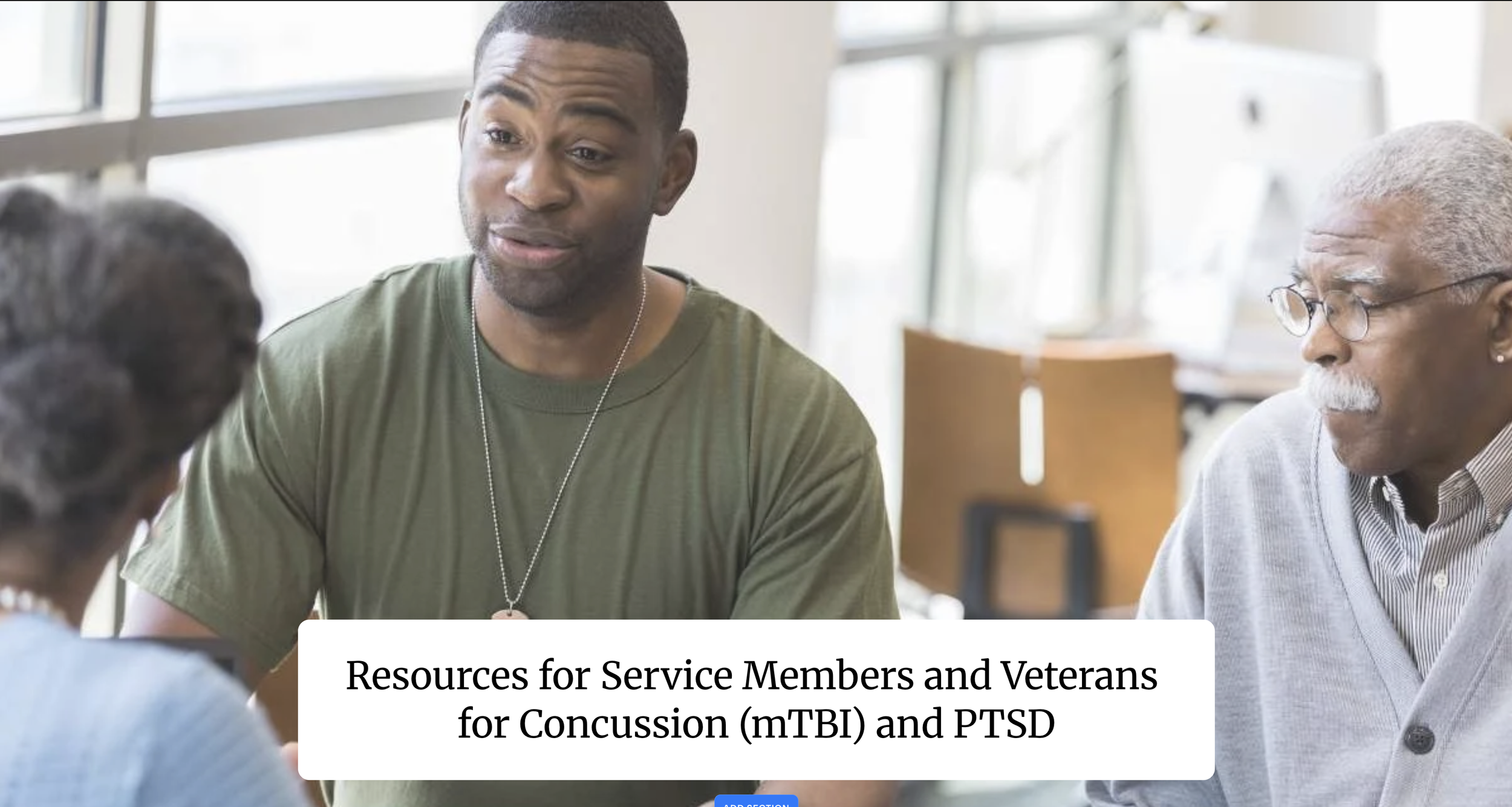
We have a group of resources for military service members and veterans on our website. You can find a list of all the resources on this page. Resource pages include:
Treatments & Self-Care
HERO study investigates heart rate variability biofeedback therapy for veterans and service members
As part of the HERO study, researchers Raouf Gharbo and James Burchat are studying the effectiveness of heart rate variability (HRV) biofeedback for veterans and service members with persisting symptoms after concussion. The researchers will evaluate the effectiveness of HRV biofeedback in alleviating symptoms such as headaches, fatigue, poor sleep, dizziness, concentration issues, and memory problems. HRV biofeedback involves doing breathing exercises while watching your heart rate in real time on a monitor. Deep breathing activates the vagus nerve, which promotes relaxation, digestion, and recovery. In an article by Olivia Trani published in VCU News, Dr. Gharbo explains, “When people learn this technique, they can use it whenever they need it. It’s not like they need a prescription for it. You already have your diaphragm; you just have to learn how to use it.”
Patients are taught to breathe through their diaphragm in a specific pattern, typically about five seconds in and five seconds out. In response, the patient’s heart rate becomes more variable, with a higher rate during the inhale and a lower rate during the exhale. Participants in the HERO study attend six weekly HRV biofeedback sessions and complete controlled breathing practices twice a day on their own. Researchers will compare this group to a control group that does not engage in HRV biofeedback.
Mental Health
TRICARE offers Talkspace online mental healthcare for military service members and their families; no referral needed in some cases

TRICARE now covers Talkspace online mental healthcare. Their coverage includes online therapy, psychiatry, teen therapy, and family therapy with licensed Talkspace providers. TRICARE is a health insurance program for active-duty and retired military service members (“retirees”) and their eligible family members. Retirees and their eligible family members covered by TRICARE can sign up directly for Talkspace mental healthcare services without a referral; however, active-duty military personnel will need a referral. TRICARE members can connect with Talkspace providers through live online sessions as well as text, video, or audio messaging.
Provider Education
An excellent webinar recording about working with veterans
(May also be useful for veterans and their families)

In this recording of a recent webinar hosted by the U-Michigan Concussion Center, Dr. Lisa Brenner, a rehab neuropsychologist, gives a comprehensive overview of the research on the relationship between mTBI, blast exposure, and PTSD in military populations, and adds military-specific recommendations for evaluation and treatment.
Clinical practice recommendations
Dr. Brenner emphasizes the importance of providers learning about the military context, including where and when the individual served; she recommends this website for information about each military conflict. She discusses how military occupational codes have been identified as a way to estimate an individual's risk of exposure to mTBI and to blast exposure. In addition, she stresses the difficulty of differentiating whether a patient's symptoms are from PTSD or TBI. Dr. Brenner recommends the Military Culture Course Modules for Healthcare Professionals produced by the Uniformed Services University Center for Deployment Psychology.
Dr. Brenner advises providers to "Treat the symptoms with evidence-based interventions," the title of her 2009 study, and this recommendation remains true today. Patients with blast or TBI history often hear from their provider statements such as "You should be recovered by now," and "These symptoms don't fit with your history." Dr. Brenner recommends that providers bypass this type of thinking, identify the most distressing symptoms, and treat those symptoms with evidence-based treatments.
In addition, Dr. Brenner recommends sharing Serving Our Voices: Stories from the Veterans History Project with their patients (stories are categorized by conflict, for example, Iraq and Afghanistan).
You Can Support Concussion Patients

Join our community of monthly donors committed to improving how concussions are prevented, managed, and treated, thereby supporting long-term brain health for all. Learn more.
You can also make an impact with a one-time gift or tax-friendly options such as Donor Advised Funds (DAFs), IRA Charitable Rollovers, and Planned Giving: leave a gift in your will. Learn more.